Name that feeling
1~2세Family Connection필요한 준비물 없음
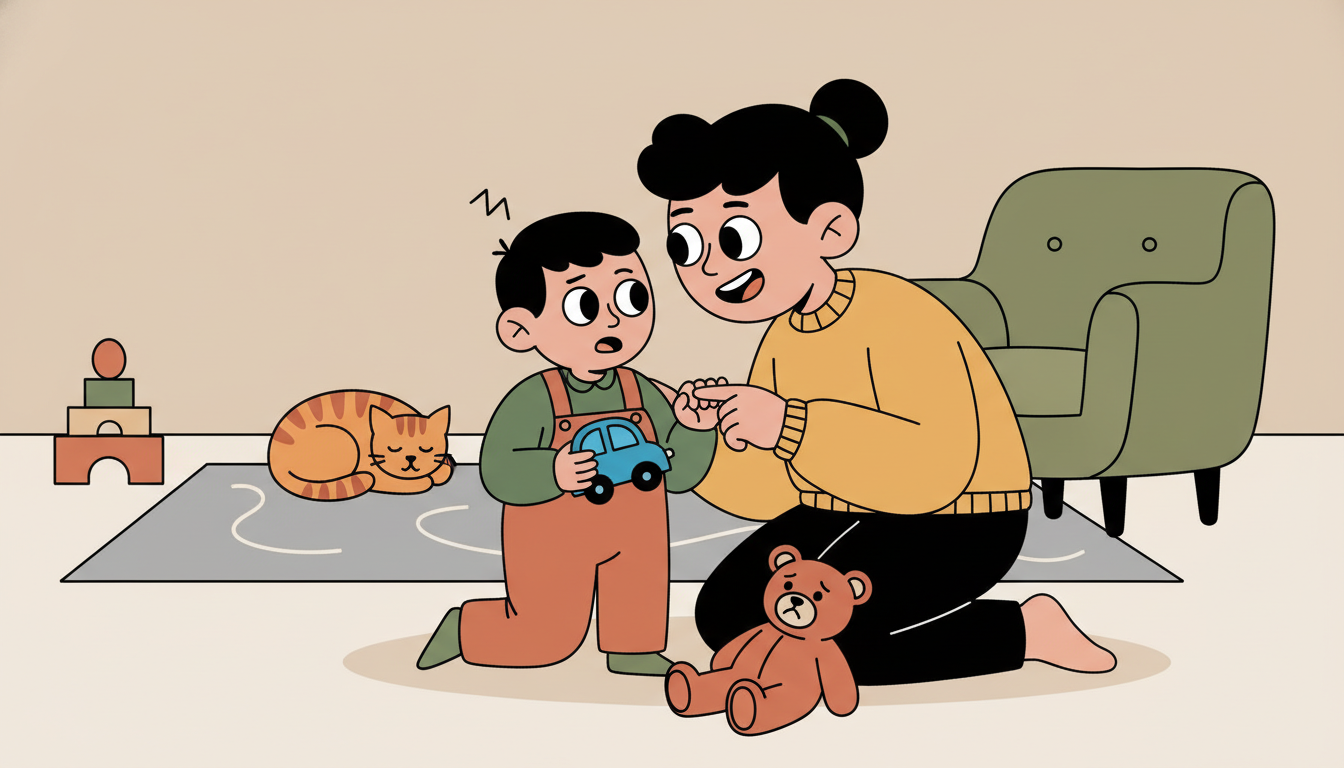
Throughout your time together, point out and name emotions you see in yourself, your child, and others around you. When your child looks frustrated with a toy, say 'You feel frustrated.' When you smile, say 'I feel happy.' When another child cries, say 'Baby is sad.' This simple labeling helps your child begin to recognize and understand emotions in themselves and others.
우리 아이에게 맞춤 설계된 Steadily 발달 여정의 일부예요.
활동 방법
Throughout your time together, point out and name emotions you see in yourself, your child, and others around you. When your child looks frustrated with a toy, say 'You feel frustrated.' When you smile, say 'I feel happy.' When another child cries, say 'Baby is sad.' This simple labeling helps your child begin to recognize and understand emotions in themselves and others.
효과가 있는 이유
Labeling emotions builds the foundation for empathy by helping children recognize feelings in themselves and others. Research shows that parental empathy toward children predicts the child's own empathy development, and when parents model emotional awareness, children learn to understand and respond to others' emotions (Liu et al., 2020). At this age, children are beginning to move from emotional contagion to early cognitive empathy, making consistent emotion labeling particularly effective.
부모를 위한 팁
Keep your emotion words simple and clear. Use the same basic emotion words consistently (happy, sad, mad, scared).
Match your facial expression to the emotion you are naming. Your child learns by watching your face.
Acknowledge your child's attempts to show concern for others, even small ones. Say 'You noticed baby is sad' when they look at a crying child.
필요한 준비물
None
학습 방식
Language-Rich EnvironmentImitation and ModelingBeginning Symbolic Play

이번 활동이 마음에 들었어? 계획은 우리가 대신 세워줄게.
Steadily는 아이의 관심사, 발달 단계, 그리고 기르고 있는 특성에 맞춰 모든 활동을 개인화해줘. 덕분에 놀이 시간이 더 즐거워지고 모든 순간이 더욱 가치 있어지지.
Steadily 작동 방식 알아보기 →