Truth or imagination game
3–4 ansSuccess MindsetAucun matériel nécessaire
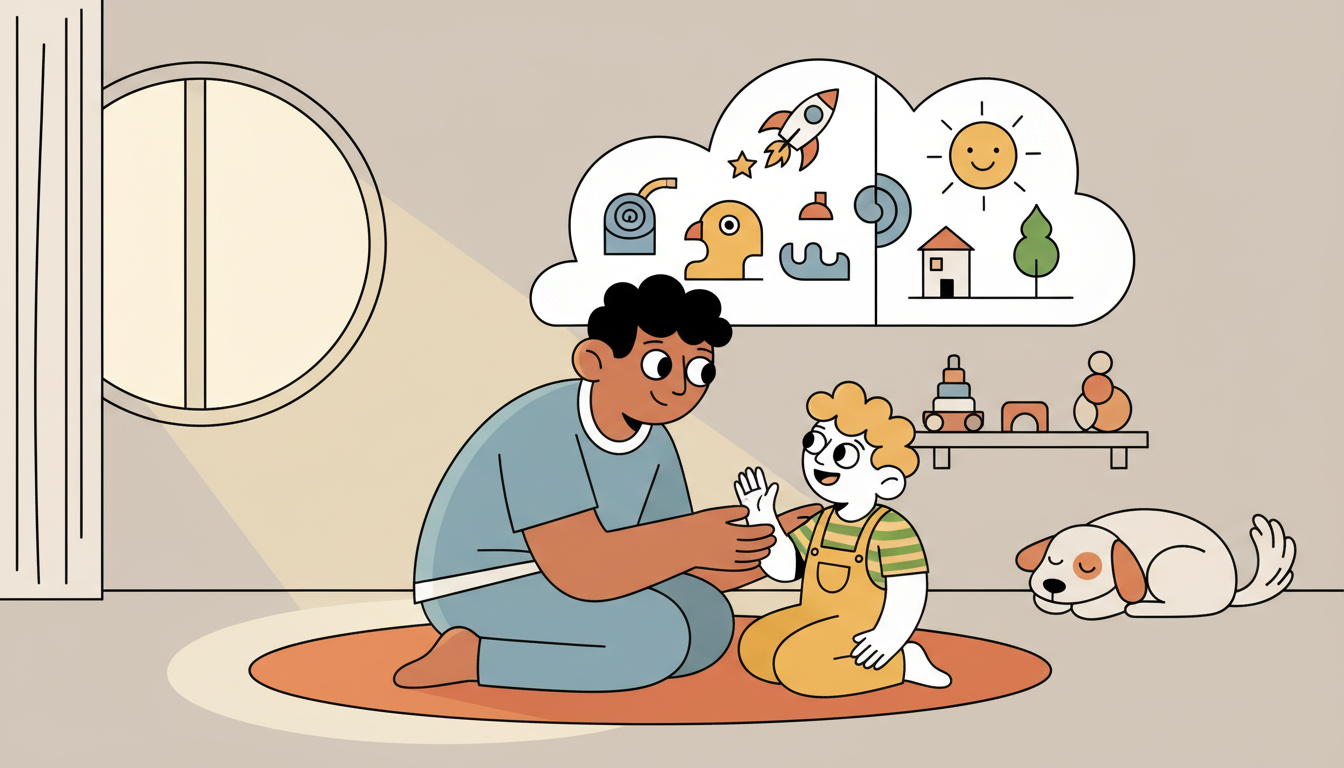
Take turns telling simple stories about your day. After each story, decide together if it was true or pretend. This helps your child distinguish between imagination and intentional deception. Make it playful and fun, celebrating both creative pretending and accurate truth-telling.
Fait partie du parcours de développement Steadily — personnalisé pour ton enfant.
Comment faire cette activité
Take turns telling simple stories about your day. After each story, decide together if it was true or pretend. This helps your child distinguish between imagination and intentional deception. Make it playful and fun, celebrating both creative pretending and accurate truth-telling.
Pourquoi ça marche
Children as young as 2 begin lying, but moral reasoning develops through middle childhood. At 36-48 months, children can begin to grasp simple moral concepts and distinguish fantasy from reality. Modeling and praising honesty are most effective approaches (Hoffman, 2000). This activity builds that distinction in an encouraging way.
Conseils pour les parents
Start by clearly labeling your own stories as "real" or "pretend" to model the difference.
Praise both creativity and honesty. Say things like, "What a fun pretend story" or "Thank you for telling me what really happened."
Matériel nécessaire
None
Méthodes d'apprentissage
Narrative and Literacy-Rich ExperiencesCollaborative and Cooperative PlayInquiry-Based Learning

Tu as aimé cette activité ? Laisse-nous planifier pour toi.
Steadily personnalise chaque activité pour ton enfant — ses centres d'intérêt, son stade de développement, les traits qu'il développe — pour que le jeu soit plus amusant et que chaque instant compte.
Découvre comment fonctionne Steadily →