The puzzle progression game
4–5 ansSuccess MindsetMatériel : Two or three puzzles of increasing difficulty
Flat surface for working
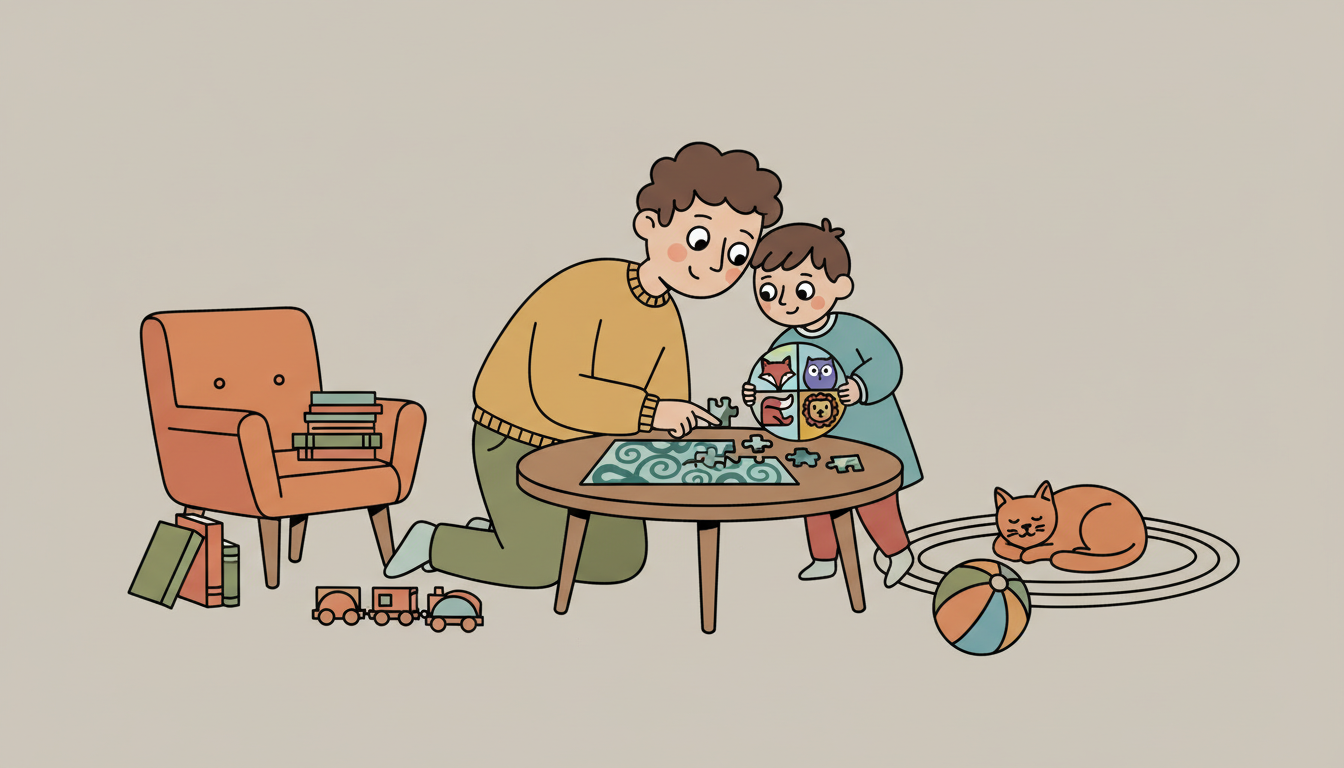
Start with a puzzle your child can already complete. Once finished, introduce a slightly harder puzzle with more pieces or smaller parts. The goal is not to finish the harder puzzle today, but to try it and notice what makes it challenging. Put it away and return to it tomorrow. Over several days, watch as pieces that seemed confusing become familiar. Talk about how their brain is learning the new puzzle, even when they are not working on it.
Fait partie du parcours de développement Steadily — personnalisé pour ton enfant.
Comment faire cette activité
Start with a puzzle your child can already complete. Once finished, introduce a slightly harder puzzle with more pieces or smaller parts. The goal is not to finish the harder puzzle today, but to try it and notice what makes it challenging. Put it away and return to it tomorrow. Over several days, watch as pieces that seemed confusing become familiar. Talk about how their brain is learning the new puzzle, even when they are not working on it.
Pourquoi ça marche
Progressively challenging activities teach children that mastery requires sustained effort over time. This approach aligns with research showing that perseverance of effort has stronger correlations with academic achievement than natural ability. A systematic review of 44 studies found that grit and its facets, particularly perseverance of effort, were positively associated with academic achievement across age groups (Lam & Zhou, 2019). At ages 4-5, children can sustain interest in complex projects over multiple sessions, making this an ideal period for building persistence through graduated challenges.
Conseils pour les parents
Choose the next difficulty level carefully. Too hard leads to frustration, not persistence.
Normalize putting the puzzle away unfinished. Say 'We'll figure out this tricky part tomorrow.'
When your child wants to quit, try working on it together for just two more minutes before stopping.
Matériel nécessaire
Two or three puzzles of increasing difficulty
Flat surface for working
Méthodes d'apprentissage
Project-Based and Thematic LearningGuided Discovery and InquiryMetacognitive Strategies

Tu as aimé cette activité ? Laisse-nous planifier pour toi.
Steadily personnalise chaque activité pour ton enfant — ses centres d'intérêt, son stade de développement, les traits qu'il développe — pour que le jeu soit plus amusant et que chaque instant compte.
Découvre comment fonctionne Steadily →