Story and feelings talk
4–5 ansFamily ConnectionMatériel : Any picture book
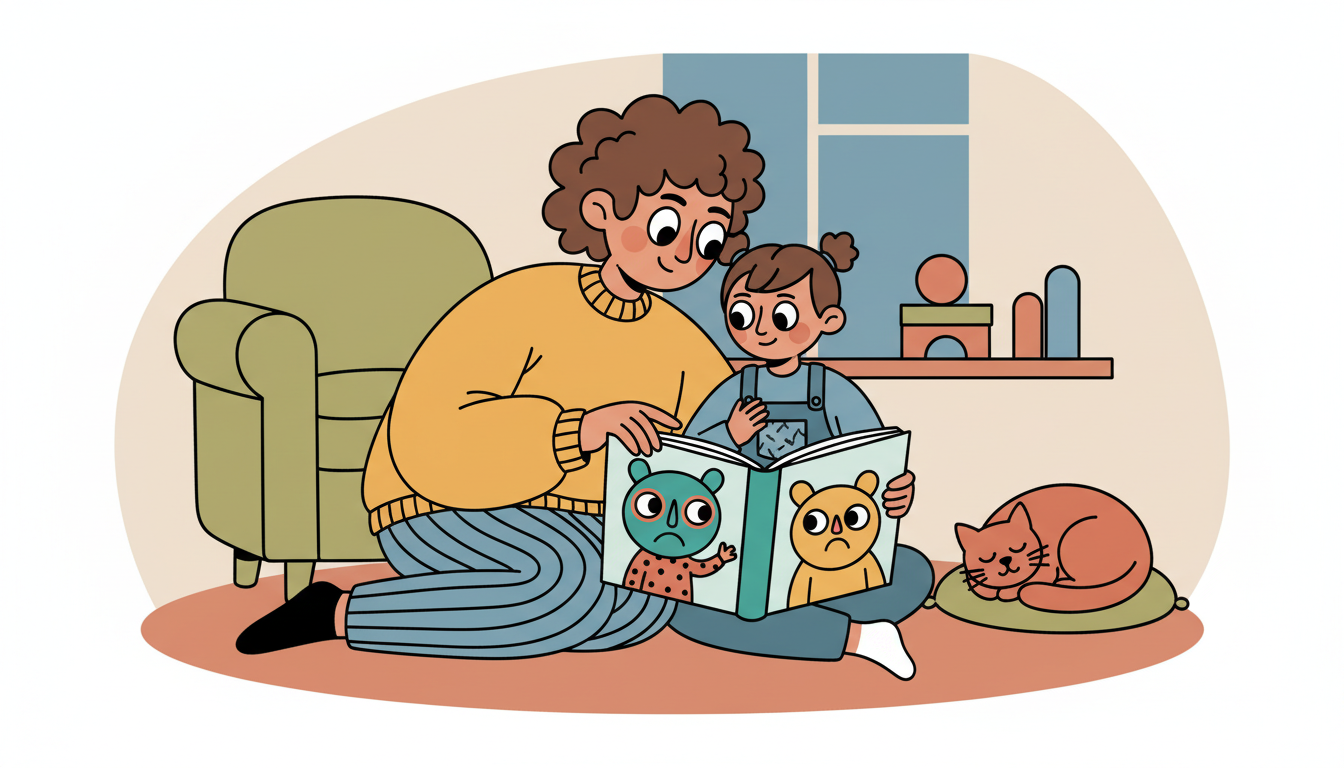
During story time, pause to talk about what characters might be feeling and why. Ask your child to identify emotions in the pictures or imagine what they would feel in that situation. Connect the story to your child's own experiences when relevant. This helps your child develop emotional vocabulary and understand that all feelings are acceptable.
Fait partie du parcours de développement Steadily — personnalisé pour ton enfant.
Comment faire cette activité
During story time, pause to talk about what characters might be feeling and why. Ask your child to identify emotions in the pictures or imagine what they would feel in that situation. Connect the story to your child's own experiences when relevant. This helps your child develop emotional vocabulary and understand that all feelings are acceptable.
Pourquoi ça marche
Secure attachment promotes the development of emotion understanding and expression. Research demonstrates that securely attached children show better emotion understanding and learn to modulate their feelings more effectively (Thompson, 2008). Talking about emotions in stories provides a safe way to explore feelings and learn that emotions can be shared and understood.
Conseils pour les parents
Use simple feeling words like happy, sad, scared, or frustrated. You can point to facial expressions in pictures to help.
Share what you notice about feelings too. You might say "I think that character looks worried because their friend left."
Matériel nécessaire
Any picture book
Méthodes d'apprentissage
Cooperative LearningMetacognitive StrategiesProject-Based and Thematic Learning

Tu as aimé cette activité ? Laisse-nous planifier pour toi.
Steadily personnalise chaque activité pour ton enfant — ses centres d'intérêt, son stade de développement, les traits qu'il développe — pour que le jeu soit plus amusant et que chaque instant compte.
Découvre comment fonctionne Steadily →