Puzzle persistence practice
4–5 ansEmotional WellbeingMatériel : Age-appropriate puzzle
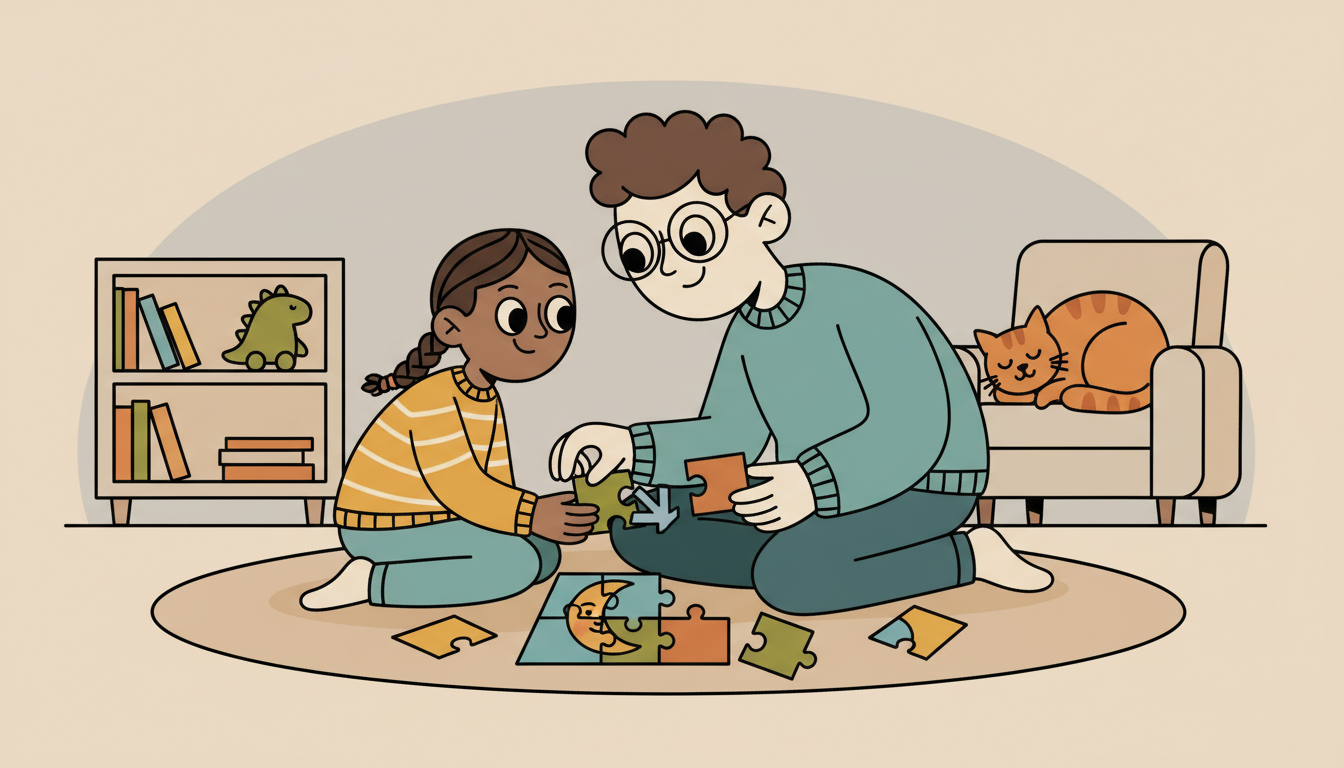
Work on a puzzle that's slightly challenging for your child's current ability. When they get frustrated, acknowledge the feeling and encourage them to take a short break or try a different piece. Guide them to notice their own problem-solving strategies. 'You turned the piece around to see if it fit better.' This teaches that taking breaks and trying different approaches are smart strategies, not giving up.
Fait partie du parcours de développement Steadily — personnalisé pour ton enfant.
Comment faire cette activité
Work on a puzzle that's slightly challenging for your child's current ability. When they get frustrated, acknowledge the feeling and encourage them to take a short break or try a different piece. Guide them to notice their own problem-solving strategies. 'You turned the piece around to see if it fit better.' This teaches that taking breaks and trying different approaches are smart strategies, not giving up.
Pourquoi ça marche
Puzzles provide concrete problem-solving challenges that build resilience through manageable difficulty. School-based resilience interventions that include problem-solving activities significantly increase study skills and academic engagement (Castro-Olivo et al., 2022). Children at this age can classify by multiple attributes and plan systematically, skills that are directly applied in puzzle-solving while building frustration tolerance and persistence.
Conseils pour les parents
Choose a puzzle with 20 to 30 pieces for an appropriate challenge level.
When frustration builds, offer a choice. 'Do you want to try a different piece or take a quick break.'
Point out their strategies as they work. 'You're looking at the colors to find matching pieces.'
Matériel nécessaire
Age-appropriate puzzle
Méthodes d'apprentissage
Guided Discovery and InquiryProject-Based and Thematic LearningMetacognitive Strategies

Tu as aimé cette activité ? Laisse-nous planifier pour toi.
Steadily personnalise chaque activité pour ton enfant — ses centres d'intérêt, son stade de développement, les traits qu'il développe — pour que le jeu soit plus amusant et que chaque instant compte.
Découvre comment fonctionne Steadily →