Feelings guessing game
4–5 ansFamily ConnectionAucun matériel nécessaire
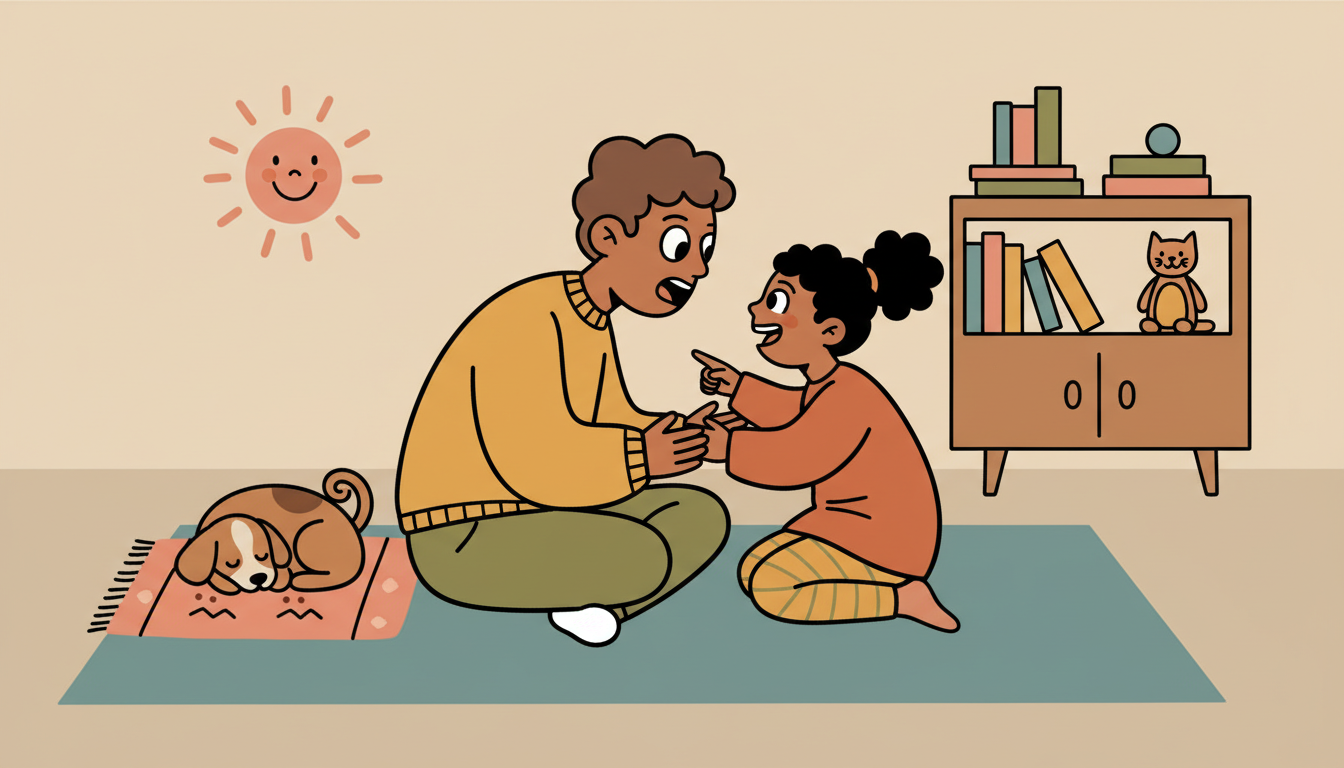
Sit together and take turns making facial expressions that show different emotions. Have your child guess what emotion you are showing, then switch roles. Start with basic feelings like happy, sad, angry, and scared, then add more complex ones like frustrated, proud, or worried. This simple game helps your child learn to read emotions from faces, a key skill for understanding how others feel.
Fait partie du parcours de développement Steadily — personnalisé pour ton enfant.
Comment faire cette activité
Sit together and take turns making facial expressions that show different emotions. Have your child guess what emotion you are showing, then switch roles. Start with basic feelings like happy, sad, angry, and scared, then add more complex ones like frustrated, proud, or worried. This simple game helps your child learn to read emotions from faces, a key skill for understanding how others feel.
Pourquoi ça marche
This activity builds cognitive empathy, which helps children understand others' perspectives and emotional states. Research shows that cognitive empathy mediates the association between positive family interactions and children's social competence, particularly helping children develop better social behaviors (Sánchez-Pérez et al., 2018). Practicing identification of emotions from facial expressions is a developmentally appropriate activity for this age when theory of mind is fully developed.
Conseils pour les parents
Start with exaggerated expressions to make it easier, then gradually make them more subtle.
When your child guesses correctly, talk about what clues they noticed, like whether your eyebrows were up or down.
Share times when you felt that emotion to make it more meaningful.
Matériel nécessaire
None
Méthodes d'apprentissage
Cooperative LearningMetacognitive StrategiesStructured Academic Learning

Tu as aimé cette activité ? Laisse-nous planifier pour toi.
Steadily personnalise chaque activité pour ton enfant — ses centres d'intérêt, son stade de développement, les traits qu'il développe — pour que le jeu soit plus amusant et que chaque instant compte.
Découvre comment fonctionne Steadily →