Fair or not fair discussions
4–5 ansFamily ConnectionAucun matériel nécessaire
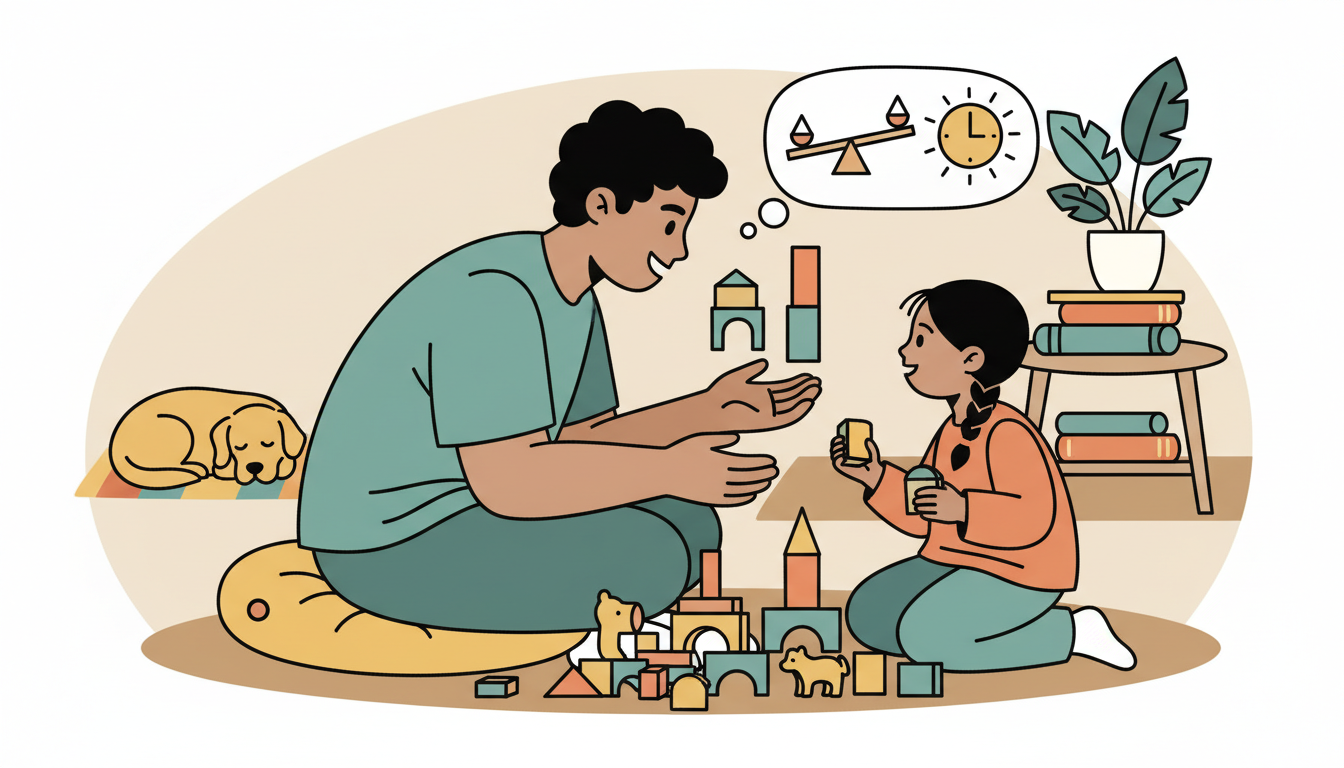
When conflicts arise, introduce the concept of fairness by asking whether proposed solutions feel fair to everyone involved. Help your child think about what fair means in different situations. Sometimes fair means equal turns, sometimes it means the person who had it first gets more time, and sometimes it means something else. Guide them to think through what makes sense for each specific situation.
Fait partie du parcours de développement Steadily — personnalisé pour ton enfant.
Comment faire cette activité
When conflicts arise, introduce the concept of fairness by asking whether proposed solutions feel fair to everyone involved. Help your child think about what fair means in different situations. Sometimes fair means equal turns, sometimes it means the person who had it first gets more time, and sometimes it means something else. Guide them to think through what makes sense for each specific situation.
Pourquoi ça marche
Collaborative problem-solving approaches in families predict better parent-child relationships during adolescence and young adulthood, with children maintaining stronger family bonds across developmental transitions (Robin & Foster, 1989). Learning to evaluate solutions for fairness develops critical thinking about relationships and builds the foundation for healthy conflict patterns. Children at this age can classify by multiple attributes and understand cause-effect, enabling them to grasp that fairness depends on context.
Conseils pour les parents
Avoid imposing your idea of fair. Instead, ask questions that help your child think it through.
Acknowledge that fair can look different in different situations.
Celebrate when your child considers fairness for all people involved, not just themselves.
Matériel nécessaire
None
Méthodes d'apprentissage
Cooperative LearningMetacognitive StrategiesStructured Academic Learning

Tu as aimé cette activité ? Laisse-nous planifier pour toi.
Steadily personnalise chaque activité pour ton enfant — ses centres d'intérêt, son stade de développement, les traits qu'il développe — pour que le jeu soit plus amusant et que chaque instant compte.
Découvre comment fonctionne Steadily →