Emotion matching partners
3–4 ansSuccess MindsetMatériel : Mirror (optional)
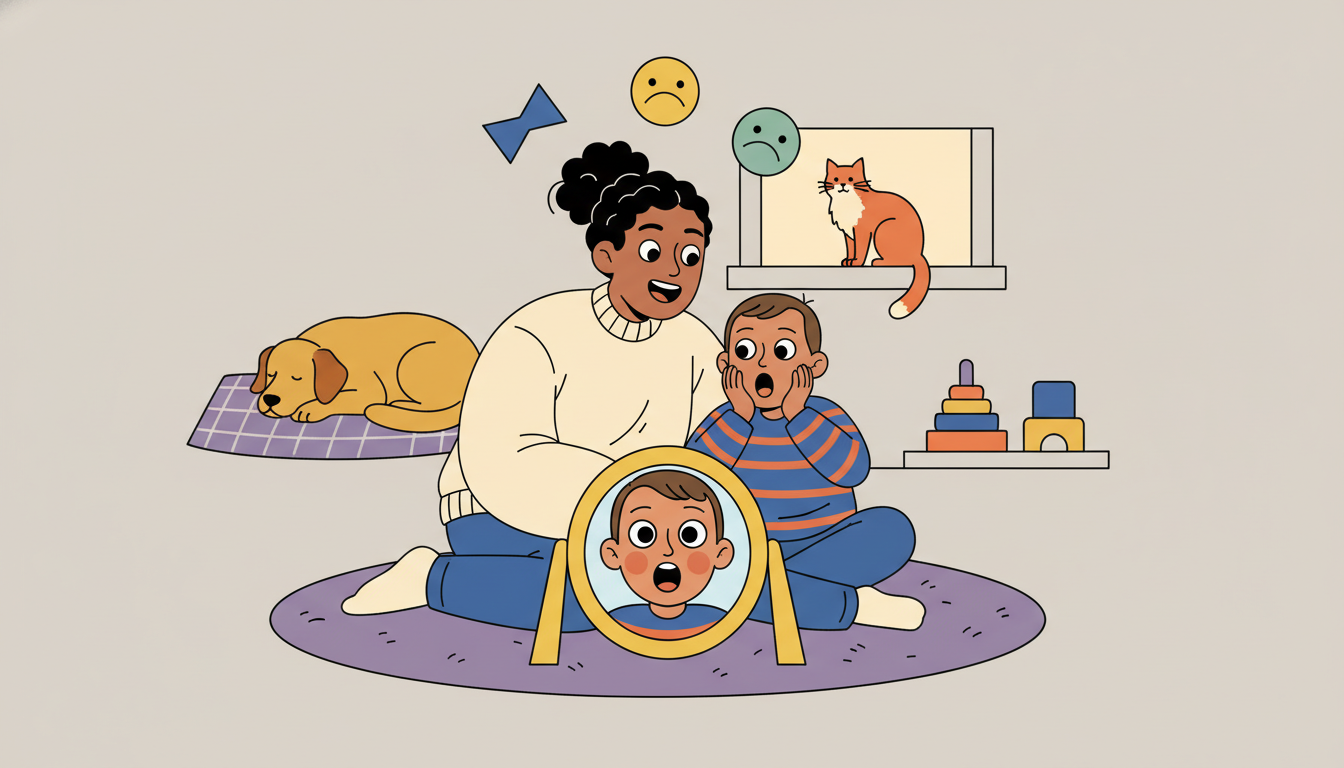
Take turns making facial expressions showing different emotions while the other person guesses the feeling. Then discuss times when you've both felt that way. This helps your child read social cues and understand that others have feelings too. You can use a mirror to practice together.
Fait partie du parcours de développement Steadily — personnalisé pour ton enfant.
Comment faire cette activité
Take turns making facial expressions showing different emotions while the other person guesses the feeling. Then discuss times when you've both felt that way. This helps your child read social cues and understand that others have feelings too. You can use a mirror to practice together.
Pourquoi ça marche
Understanding and responding to social cues is a core component of social intelligence that predicts later success. Children with better social skills showed 50-70% higher likelihood of stable adult employment and educational completion (Durlak et al., 2011). At 36-48 months, theory of mind development enables perspective-taking, making this the optimal window for practicing emotion recognition and empathy skills that form the foundation of positive peer relationships.
Conseils pour les parents
Start with basic emotions like happy, sad, angry, and surprised before moving to more complex ones.
Share real examples: 'I felt frustrated when the car wouldn't start. When do you feel frustrated?'
Validate your child's interpretations even if they're not exact. The practice of reading cues matters most.
Matériel nécessaire
Mirror (optional)
Méthodes d'apprentissage
Collaborative and Cooperative PlayStructured Learning ActivitiesProject-Based Learning

Tu as aimé cette activité ? Laisse-nous planifier pour toi.
Steadily personnalise chaque activité pour ton enfant — ses centres d'intérêt, son stade de développement, les traits qu'il développe — pour que le jeu soit plus amusant et que chaque instant compte.
Découvre comment fonctionne Steadily →