How do you feel today
2–3 ansFamily ConnectionAucun matériel nécessaire
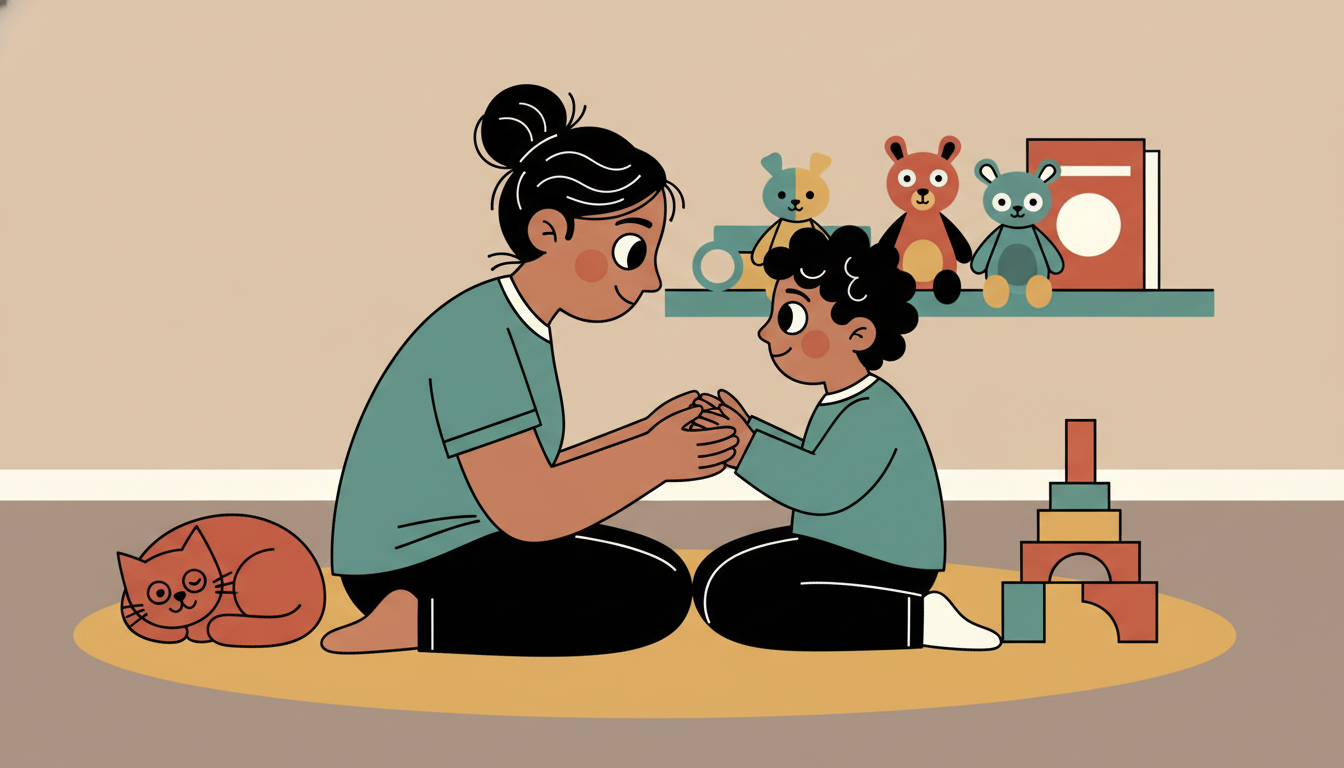
During a quiet moment together, talk about feelings. You might start with 'I feel happy today because we are playing together.' Then ask 'How do you feel?' Accept whatever your child says. Name the feeling and connect it to something specific, like 'You feel excited about the park.'
Fait partie du parcours de développement Steadily — personnalisé pour ton enfant.
Comment faire cette activité
During a quiet moment together, talk about feelings. You might start with 'I feel happy today because we are playing together.' Then ask 'How do you feel?' Accept whatever your child says. Name the feeling and connect it to something specific, like 'You feel excited about the park.'
Pourquoi ça marche
Labeling emotions in self and others builds the foundation for empathy. When parents model empathy and validate children's emotional experiences, children develop better social competence and fewer behavioral problems (Liu, S., Wang, L., Zhang, L., & Tian, L., 2020). Children at this age are beginning to develop language for emotions, making this the ideal time to practice emotional vocabulary together.
Conseils pour les parents
Use simple feeling words. Happy, sad, mad, and scared are good starting points.
Share your own feelings first. This models emotional awareness and makes it safe for your child to share.
Matériel nécessaire
None
Méthodes d'apprentissage
Symbolic and Pretend PlaySongs, Stories, and RhymesSocial Learning Through Peers

Tu as aimé cette activité ? Laisse-nous planifier pour toi.
Steadily personnalise chaque activité pour ton enfant — ses centres d'intérêt, son stade de développement, les traits qu'il développe — pour que le jeu soit plus amusant et que chaque instant compte.
Découvre comment fonctionne Steadily →