Feelings picture walk
3–4 ansFamily ConnectionMatériel : Family photos or photo album
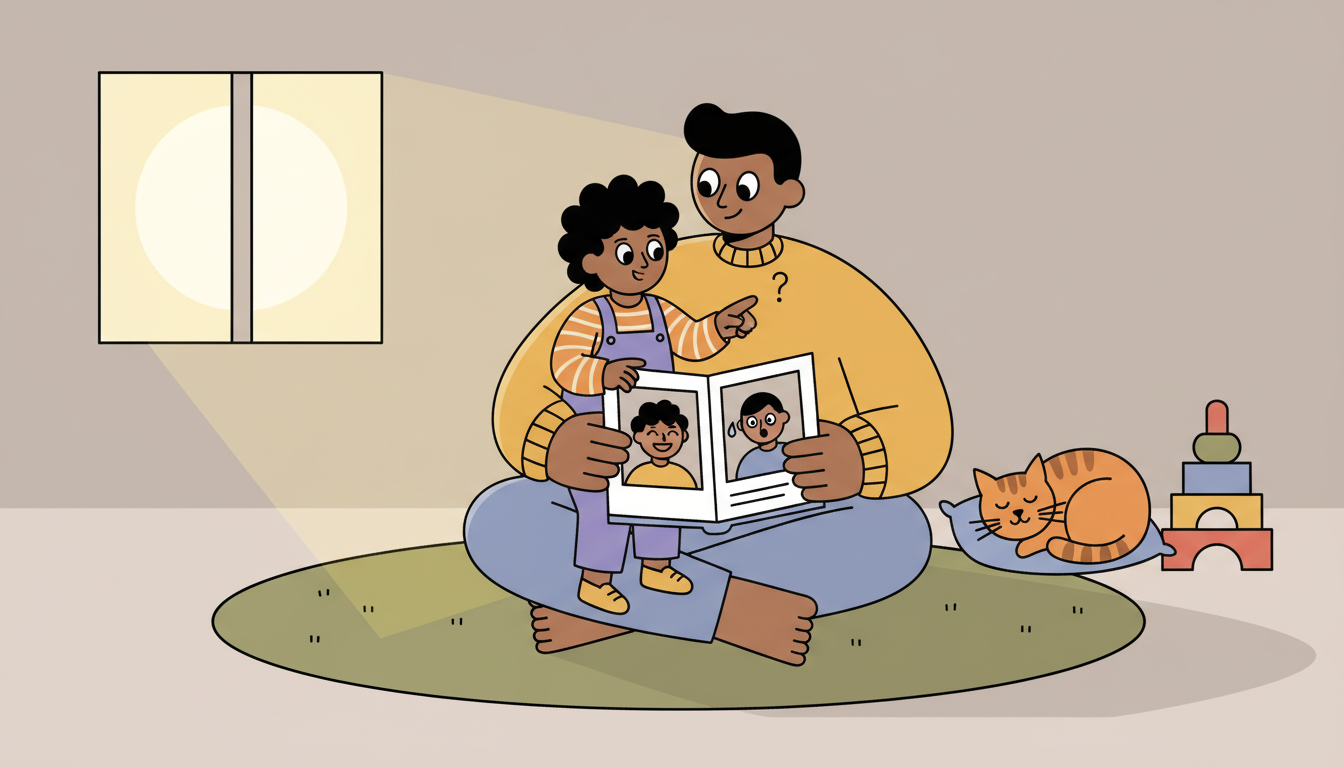
During your activity time, look at family photos together and talk about how people felt when each picture was taken. Ask your child to point out happy faces, sad faces, or surprised faces. Take turns guessing what made each person feel that way. You can say things like, 'Look at grandma's smile. How do you think she felt that day? What made her so happy?' This simple practice helps your child learn to read emotions in others.
Fait partie du parcours de développement Steadily — personnalisé pour ton enfant.
Comment faire cette activité
During your activity time, look at family photos together and talk about how people felt when each picture was taken. Ask your child to point out happy faces, sad faces, or surprised faces. Take turns guessing what made each person feel that way. You can say things like, 'Look at grandma's smile. How do you think she felt that day? What made her so happy?' This simple practice helps your child learn to read emotions in others.
Pourquoi ça marche
Recognizing and responding sensitively to others' emotions is a key childhood behavior that predicts stronger adult empathy and relationship quality (Eisenberg et al., 2015). At 36-48 months, children develop theory of mind, which allows them to understand that others have different thoughts and feelings. Looking at photos provides a safe, concrete way to practice identifying emotions in faces and body language. This skill forms the foundation for empathetic responses later.
Conseils pour les parents
Start with obvious emotions like big smiles or tears before moving to subtle expressions.
If your child struggles, give them two choices like 'Does she look happy or sad?'
Share your own feelings from the photos to model emotional awareness.
Matériel nécessaire
Family photos or photo album
Méthodes d'apprentissage
Narrative and Literacy-Rich ExperiencesCollaborative and Cooperative PlayInquiry-Based Learning

Tu as aimé cette activité ? Laisse-nous planifier pour toi.
Steadily personnalise chaque activité pour ton enfant — ses centres d'intérêt, son stade de développement, les traits qu'il développe — pour que le jeu soit plus amusant et que chaque instant compte.
Découvre comment fonctionne Steadily →