Thank you wave practice
1–2 JahreEmotional WellbeingKeine Materialien erforderlich
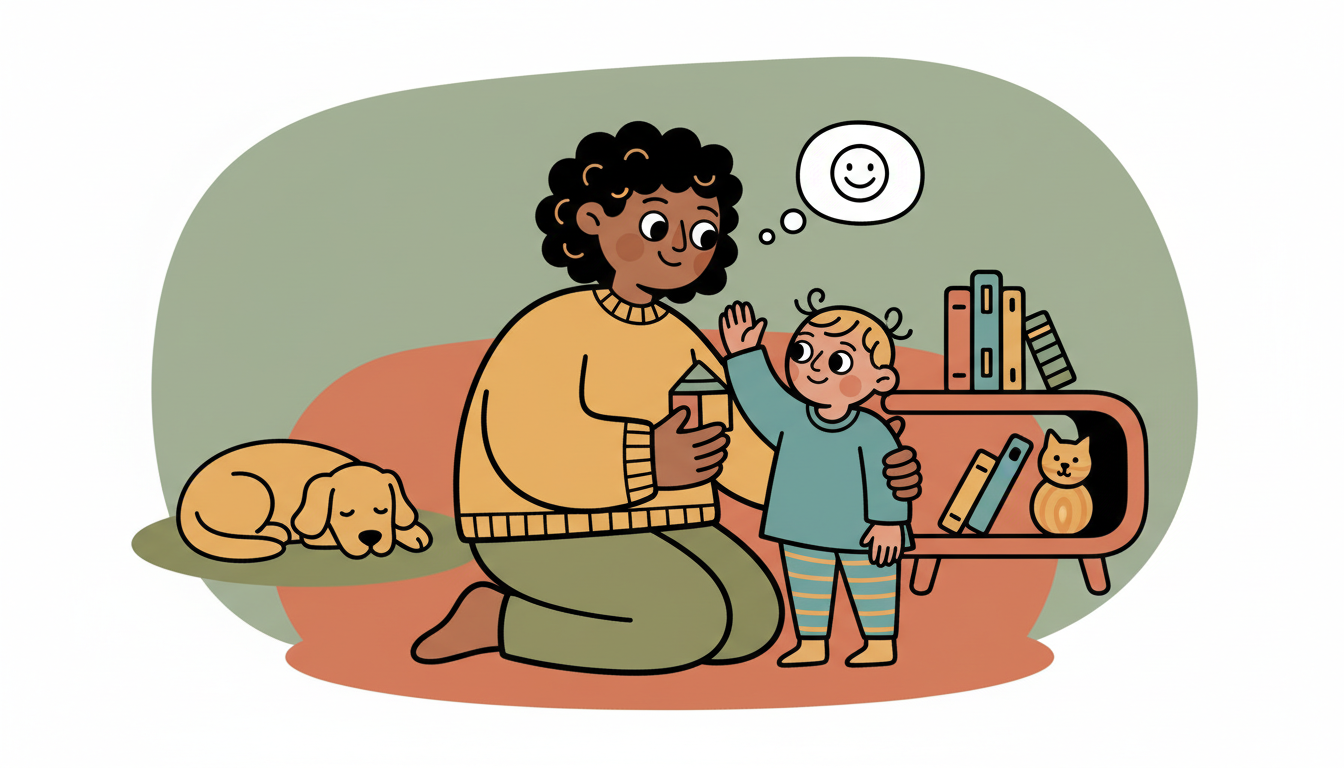
When someone hands your child a toy, snack, or book, model a gentle wave and say thank you. Guide your child's hand to wave too. Use a warm, clear voice each time. Your child learns to connect the action with receiving something kind. This works during playtime, meals, or any moment when someone offers help.
Teil der Steadily-Entwicklungsreise — personalisiert für dein Kind.
So geht diese Aktivität
When someone hands your child a toy, snack, or book, model a gentle wave and say thank you. Guide your child's hand to wave too. Use a warm, clear voice each time. Your child learns to connect the action with receiving something kind. This works during playtime, meals, or any moment when someone offers help.
Warum es funktioniert
Toddlers learn social behaviors through imitation and modeling, as shown in Bandura's social learning theory. At this age, children can follow simple one-step instructions and learn gratitude routines by copying adults. Research shows that childhood gratitude habits developed through regular acknowledgment predict adult gratitude practices, with adults who practice gratitude experiencing 15% greater life satisfaction (Emmons & McCullough, 2003).
Tipps für Eltern
Keep it simple and repeat often. Your child learns through watching you.
Make eye contact with your child when modeling the wave and thank you.
Celebrate when your child tries to wave or say thanks, even if it's not perfect.
Benötigte Materialien
None
Lernmethoden
Language-Rich EnvironmentImitation and Modeling

Hat dir diese Aktivität gefallen? Lass uns die Planung für dich übernehmen.
Steadily personalisiert jede Aktivität für dein Kind — seine Interessen, seine Entwicklungsstufe, die Eigenschaften, die es aufbaut — damit die Spielzeit mehr Spaß macht und jeder Moment zählt.
Erfahre, wie Steadily funktioniert →